

While exploring the shores of Scarborough or other areas of coastal Maine, you are very likely to come across a European green crab (Carcinus maenas), a species invasive to North America and widespread across New England’s coast. In more recent years, though, a new kind of crab has begun to appear, popping up in crab and lobster traps increasingly often- the Atlantic blue crab. In theory, the Atlantic blue crab (Callinectes sapidus) has a range extending from Argentina all the way up to Nova Scotia. However, it has historically been quite rare to find them anywhere north of Cape Cod. They are salt marsh specialists, preferring brackish water, and they are especially common in the milder climate of the mid-Atlantic and Chesapeake Bay regions. However, our own Gulf of Maine is widely considered to be one of the fastest warming bodies of ocean water in the world, and as the water has heated, blue crabs have ventured further north. A network of organizations ranging from Northern Massachusetts to mid-coast Maine have begun to track their presence as part of a project funded by Maine Sea-Grant. These community organizations introduce local crab-trapping projects meant to discover the whereabouts and habits of the newcomers. Notably, the National Estuarine Research Reserve (NERR) in Wells has been trapping blue crabs since 2020, and along with the conservation group, Manomet, has found hundreds of crabs over the last few years.
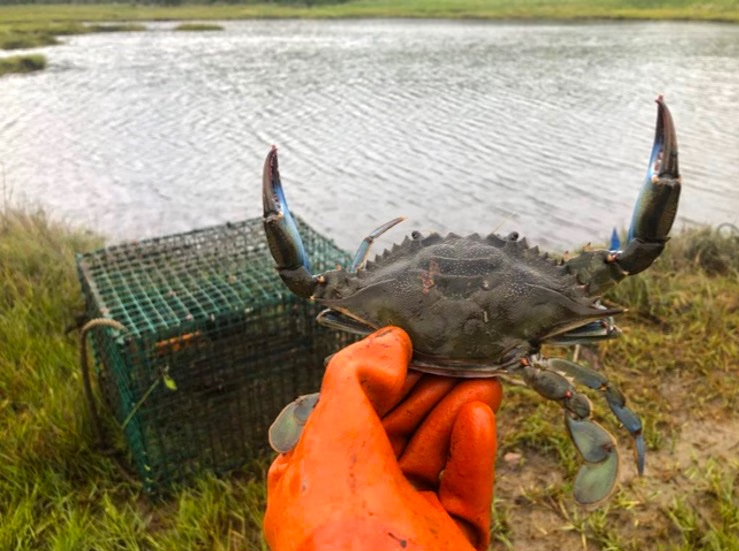
Figure 1: Blue Crab in Wells, ME. Photo: Laura Crane, Wells National Estuarine Research Reserve
As we continue to see blue crabs throughout waterways and coastal areas near us, it is necessary to understand what changes they may bring to local ecosystems. These crabs have similar diets to green crabs, meaning they will eat clams and other mollusks. They may even go after juvenile lobsters. It is important to note, though, that blue crabs are a larger and more aggressive species, often preying on green crabs. As a result, these crustaceans have the potential to significantly disrupt the food web in the Gulf of Maine.
Since blue crabs used to be a rare find here, there are no specific harvest regulations or management plans for the species in New Hampshire or Maine. Tracking and studying these crustaceans will help to make their impact on coastal Maine’s marshes and estuaries more clear, informing management strategies as they become increasingly common in our waters.
In 2025, Scarborough Land Trust joined this network of community partners along with Dr. Steven Jury, a researcher and professor at Saint Joseph’s College, and a few of his excellent students. We have been working together on a blue crab-tracking project in the Scarborough Marsh. Together, SLT staff, interns, and Saint Joseph’s students deploy traps throughout the marsh to detect and monitor blue crabs as they expand northward. As of July 2026, no blue crabs have been found in the Scarborough Marsh. However, each trap check consistently captures several green crabs, providing valuable opportunities to study this invasive species while contributing to a broader effort to monitor blue crab populations throughout the Gulf of Maine.
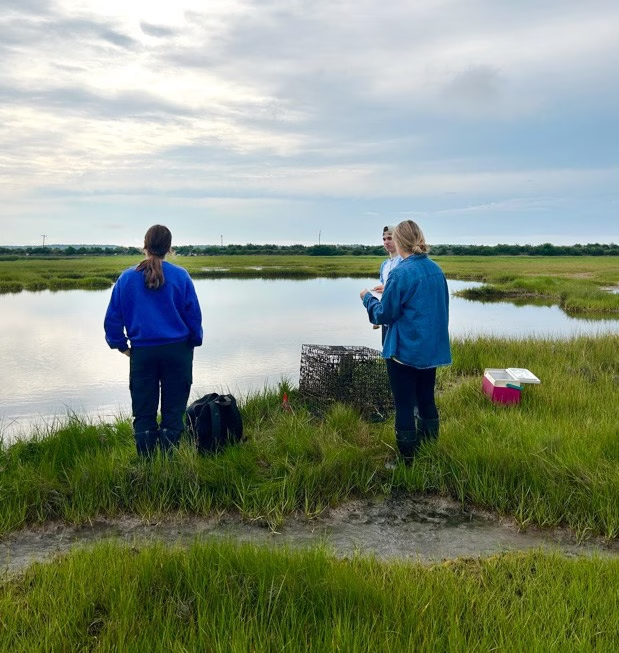
Figure 2: SLT interns and Saint Joseph’s students checking a crab trap. Photo: Lauren Ballou